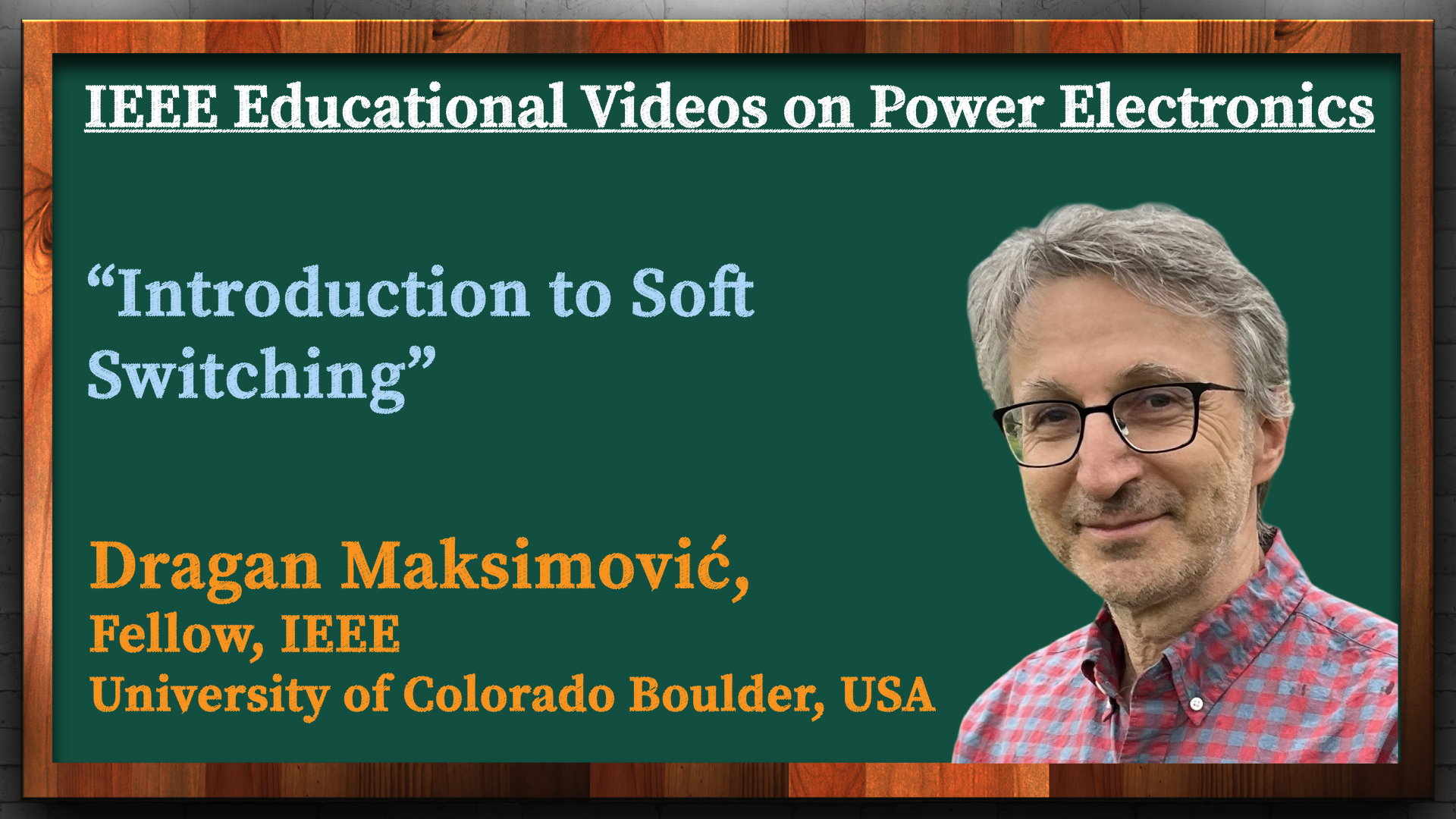
Introduction to Soft Switching
DOI:
https://doi.org/10.17024/pelstube.2026.005Keywords:
Soft switching, Switching loss, Resonant power conversion, Switched-mode power convertersAbstract
This short video presents an introduction to the concepts of hard versus soft switching, zero-voltage switching (ZVS), resonant transitions, zero-current switching (ZCS), and how all of these relate to loss mechanisms in switched-mode power converters. A standard half-bridge configuration is used to illustrate the characteristics of switching transitions and the associated losses under hard-switching conditions. The video then presents a basic soft-switching technique, highlighting how major switching losses, particularly during turn-on, can be significantly reduced through zero-voltage switching. Simulations of a synchronous buck converter are used to compare the loss budget between hard and soft switching scenarios. The video concludes with a summary of the advantages of soft switching, along with important design trade-offs such as increased voltage or current stresses and the potential for higher conduction losses.
Downloads
References
Robert W. Erickson and Dragan Maksimović, Fundamentals of Power Electronics, 3rd edition, Springer 2020.
C. P. Henze, H. C. Martin and D. W. Parsley, “Zero-voltage switching in high frequency power converters using pulse width modulation,” IEEE APEC 1988.
D. Maksimović, “Design of the zero-voltage-switching quasi-square-wave resonant switch," IEEE PESC 1993.
C. Marxgut, F. Krismer, D. Bortis and J. W. Kolar, "Ultraflat Interleaved Triangular Current Mode (TCM) Single-Phase PFC Rectifier," in IEEE Transactions on Power Electronics, vol. 29, no. 2, pp. 873-882, Feb. 2014.
Downloads
Published
How to Cite
Issue
Section
License
Copyright (c) 2026 Dragan Maksimović

This work is licensed under a Creative Commons Attribution-NonCommercial-NoDerivatives 4.0 International License.